
We want you to do the minimum.
A text, a prompt, a forwarded email, a message to Claude — we don't care how it gets to us. Just tell us what needs to happen.
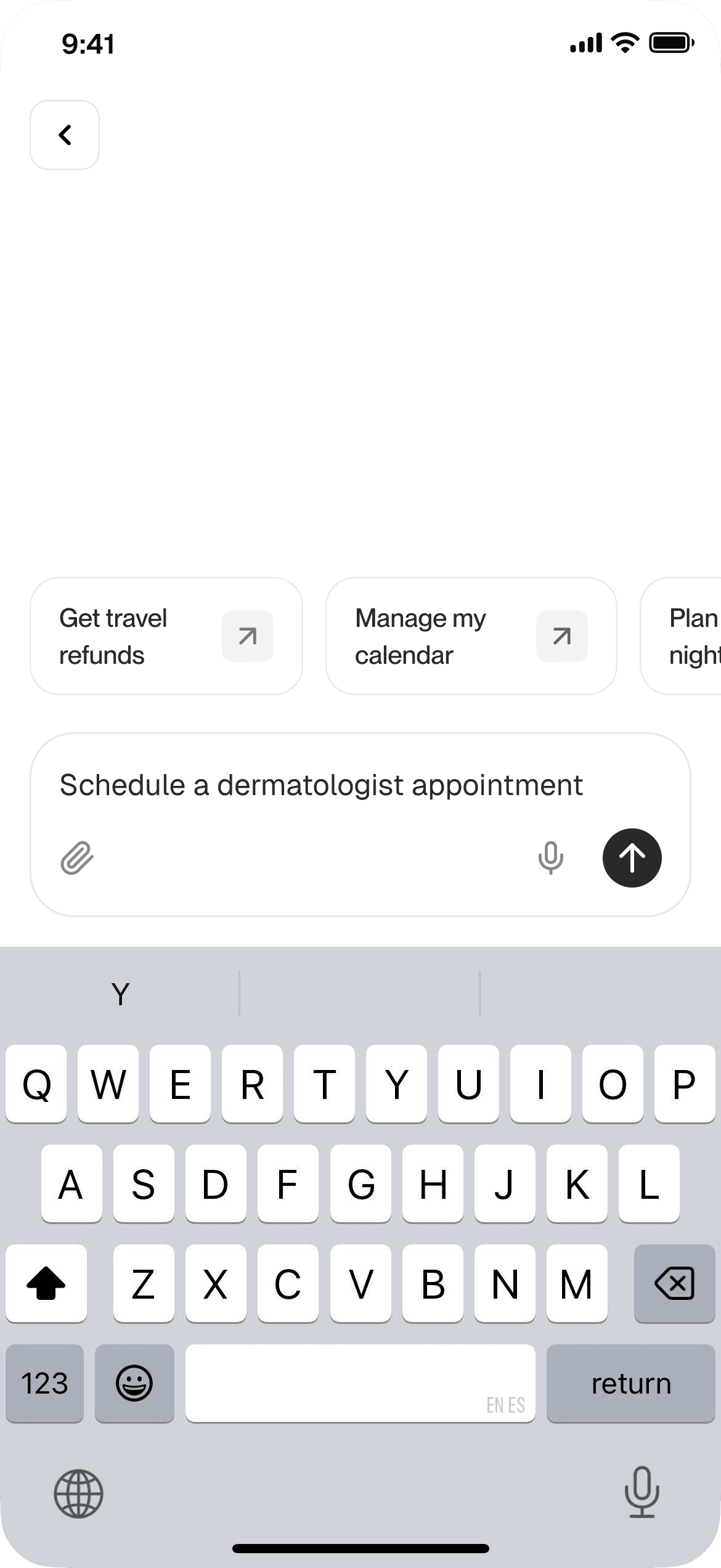
Finally: a productivity tool that requires you to do less, not more.
The soul-crushing stuff is kind of our thing.
Customer service & red tape
Refunds, disputes, billing errors, cancellations
- Fight a $200 flight change fee
- Negotiate a lower cable bill
- Call about a denied insurance claim
Vendor research & discovery
Quotes, comparisons, finding people who don't have websites
- Get quotes from 3 moving companies
- Find the best price on a specific mattress
- Compare contractors and tell me which to pick
Appointments & reservations
Doctors, dentists, salons, restaurants, mechanics
- Book a doctor who takes your insurance and has openings this year
- Reserve a restaurant that doesn't take online reservations
- Schedule car maintenance at the dealer
In the age of AI, everyone's trying to automate humans out of existence. We went the other direction.
Because the real world runs on nuance, complexity, and people who say no the first time. Humans handle the part where you need to argue with someone who's contractually obligated to say no.
Sound familiar?
AI that researches doctors but can't book an appointment
Chatbots that draft dispute letters nobody reads
Agents that "browse the web" but can't navigate a phone tree
Automations that notify you a task is overdue (thanks, you prompted that yourself)
An LLM that knows your insurance is wrong but can't sit on hold for 38 minutes to fix it
Duckbill does this.
Your insurance claim. Disputed and won. $847 back.
Your Comcast bill. Negotiated down $47/mo.
Your doctor. Takes your insurance, has openings this month.
Your gym membership. Actually canceled.
Your to-do list. The "AI can't do this" pile. Gone.
Every other AI company is trying to replace humans. We're the only one hiring them.
Built for:
People who need things done.
You have a list. We handle it. Phone calls, errands, arguments, logistics — the stuff that's been sitting there for weeks. Tell us what needs doing. We finish it.
People who build AI products.
Your agent figured out the answer. Duckbill finishes the job. Plug real human execution into any AI workflow. Your agent's completion rate goes from 60% to 95%.
People who get things done.
You're the reason any of this works. Background-checked humans who make the calls, run the errands, and close the loop. Flexible, AI-augmented work that pays.
People Are Saying Things
Mostly good. Some still in shock.
"Claude explained my insurance policy better than my insurance company. Duckbill called my insurance company. Good team."
— Reluctant delegator
"I told them I was moving and they just… handled it. All of it. I don't even know how many calls they made."
— Person who moved without lifting a phone
"I gave them something I'd been avoiding for 6 months. Done in 20 minutes. I'm not okay."
— Founder who procrastinates
"Duckbill called Comcast for me and I think they enjoyed it."
— Startup Founder
"I used to spend Wednesdays on hold. Now I spend Wednesdays working."
— Executive
"I haven't called an airline in 8 months and my life is measurably better."
— Frequent Flier
"I said 'plan my kid's birthday, she likes horses, we have $300.' Got a full party back."
— Parent who did the bare minimum and looked like a hero
"I forwarded one email about a denied claim. Four follow-ups and an appeal later, $4,200 back."
— Someone who would have just eaten the cost
"They negotiated my cable bill down $40/month. I've been overpaying for 3 years like an idiot."
— Reformed Cable Subscriber
"Claude explained my insurance policy better than my insurance company. Duckbill called my insurance company. Good team."
— Reluctant delegator
"Duckbill called Comcast for me and I think they enjoyed it."
— Startup Founder
"I said 'plan my kid's birthday, she likes horses, we have $300.' Got a full party back."
— Parent who did the bare minimum and looked like a hero
"I told them I was moving and they just… handled it. All of it. I don't even know how many calls they made."
— Person who moved without lifting a phone
"I used to spend Wednesdays on hold. Now I spend Wednesdays working."
— Executive
"I forwarded one email about a denied claim. Four follow-ups and an appeal later, $4,200 back."
— Someone who would have just eaten the cost
"I gave them something I'd been avoiding for 6 months. Done in 20 minutes. I'm not okay."
— Founder who procrastinates
"I haven't called an airline in 8 months and my life is measurably better."
— Frequent Flier
"They negotiated my cable bill down $40/month. I've been overpaying for 3 years like an idiot."
— Reformed Cable Subscriber
It's time to duck it.
Everything annoying you've been putting off. Consider it handled.
AI plans it. Let us finish it.
Two ways in. Same humans. Same results.
Same background-checked humans either way. We don't care how the task gets to us.